

KEEPIN' YOUR SPINE FEELIN' FINE
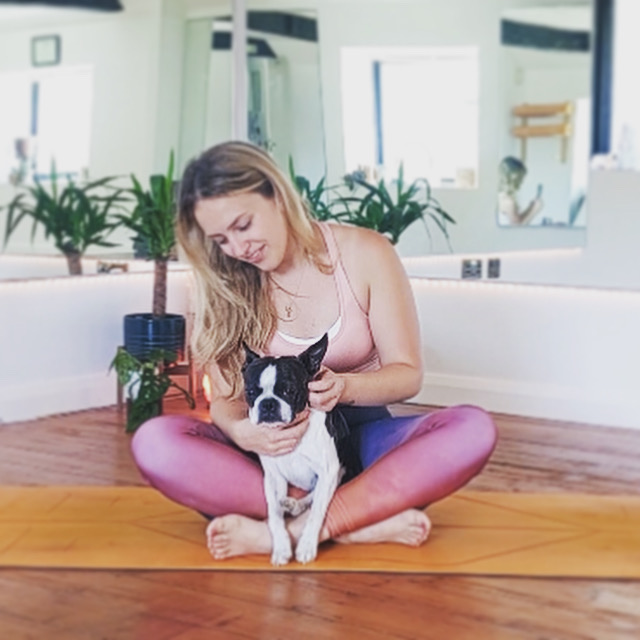
Hands up if you love a backbend?! 🙌🏼 They look cool, they feel great, and they can help us und the habitual slouch many of us adopt thanks to hunching over screens (*immediately sits up straighter in my chair*)
But before we start bending over backwards, let’s hit rewind and remember the bloody important functions of our spines. Spoiler alert, it's not to achieve Wheel pose...

The function of the spine
Your spine has three crucial functions - and none of them involve contortion.
1. Protects the spinal cord
Every vital organ in the body is protected by bone. Just like the skull houses the brain and the ribcage contains the heart and lungs - the spine protects your spinal cord - the cable of nerves that transport messages from your brain to the rest of your body.
The brain and the spinal cord, make up your central nervous system (CNS), which translates the stimuli around you into action and behaviour; from taking your hand off a hot stove, to laughing when something's funny, or choosing the right words to say.
So the CNS basically controls how we show up in the world - all of our bodily functions, physical actions, thoughts and emotions - therefore protecting this bundle of nerves, and the spine which encases it, is far more important than getting into a fancy backbending asana.
2. Structural support
Your spine is your body’s scaffolding. The Sanskirt word Danda, which means staff/stick or rod, relates to the spine. It gives your body an upright structure, and holds everything together. Without it, we’d just be a floppy mess of skin and organs 🫠
3. Movement
Despite being strong and sturdy, your spine is also wonderfully dynamic - allowing us to twist and lean and reach. If it were a solid bone (like the femur), we’d be rather stuck up. But thankfully there's more to it. 33 times more to be exact...
Anatomy of the Spine
SKELETAL
The spine isn’t one long rod, it's made up of lots of little bones called vertebrae which, like a string of beads allow us to bend and twist. There's 33 vertebrae in the spine, divided into five sections. The bottom 9 make up the Coccyx & Sacrum, but these verterbrae are fused together, meaning there's no movement there. The remaining 24 vertebrae make up the moveable sections of the spine:
Cervical (neck) – The top 7 vertebrae make up your neck, these are super mobile so you can look around easily.
Thoracic (upper back) – The next 12 vertebrae make up the T spine. This part of the back is pretty good at rotation, but has limited extension. (As with everything in the human body, there's a valid reason for this - this area is where the spine attaches to the ribcage, and needs to stay fairly sturdy to protect our vital organs, and so the spineous processes (the pokey bits that stick out) on these 12 vertebrae are longer to reduce the ability to open up and expose the heart and lungs.)
Lumbar (lower back) – The next 5 vertebrae make up the lumbar spine. These bones have larger gaps between them, in order to create a wider range of movement, like flexion (bending forward) and extension (bending backwards)
Between the vertebrae we find intervertebral discs — like squishy cushions that absorb shock and allow movement, without these we'd be moving bone on bone, eventually grinding it down and causing damage to the discs or even nerves.
The spine isn’t actually straight — it has a natural S-shaped curve. So when I say sit up with a nice straight spine, what I really mean is embrace your natural curves.
But sometimes these curves become exaggerated, which can lead to postural problems and pain imbalances:
Excessive lumbar curve?

That’s lordosis – it can be genetic, caused by carrying too much weight/pregnancy or even a learned posture to "look sexy", but it can lead to lower back pain, weak core muscles, and tight hip flexors.
Excessive upper back curve?

That’s kyphosis – It's common to adopt a kyphotic posture in old age, but also in our increasingly sedentary lifestyles slumping over phones and computers. Kyphosis can limit breathing by compressing the ribcage and cause pain in the upper back and neck.

Scoliosis – A naturally occurring deformity of the spine and harder to treat, unlike kyphosis and lordosis which can be managed or reversed with postural work and strength training.
MUSCULAR
Your moveable vertebrae can't do much without the muscles doing the work.
The main muscles of the spine are the spinal erectors — a long set of muscles running either side of the spine. They work together (like in a symmetrical backbend) or independently (when side bending).
But it’s not just about the back. The whole core stabilises the spine:
Rectus abdominis (6-pack)
Obliques (waist)
Transverse abdominis (deep core)
Quadratus lumborum (sides of your back)
Pelvic floor + diaphragm (internal)
Together, these muscles form a 360° supportive corset to help maintain spinal health in movement and stillness. So if you want to keep your spine feelin' fine, we must focus on this whole group of muscles as a team.
Yogic Anatomy - The Nadis
So - you can see why a healthy spine is pretty vital - to avoid pain, to move functionally and to protect the CNS which basically controls life. And if you've been coming to my classes for a while you'll know that I get all nerdy when ancient yogic knowledge mirrors western science.
Yogic anatomy - that subtle energetic anatomy that we can't see but has been passed down by sages for centuries - places the nadis alongside the physical spinal cord.
The nadis are invisible energy channels running from the base of the spine to the brain, carrying "prana" life force (or perhaps what we understand as nerve signals). When the nadis became blocked, prana can not flow freely, causing pain and ailments. The solution? Movement. Asana. Twists and backbends and folds.
Our western anatomy textbooks might not be quite so poetic about it, but moving the spine is still vital to ensure optimum health - circulation, mobility, neurological function.
No matter your preferred language - prana or nerve signals, nadis or spinal cord - the message is the same: spinal movement = optimum vitality.
Befriend your backbends
People often think of backbends being for super flexible people. But it's not about being bendy - it's about being strong. There's a lot of muscular contraction happening in a backbend - particularly in your posterior chain. The glutes, the spinal erectors, the whole core - they all need to be firing. There should be no passive muscles... except maybe in the jaw! 😬
And beyond the core - let's talk about the glutes and the hip flexors. These can be either a gateway or a barrier to accessing backbends. We need strong glutes to stabilise the pelvis, and flexible hip flexors to lengthen the front body.
Backbend Physiology
Physiology relates the the responses and reactions that occur in the body. Backbends can leave us feeling energised, exhilarated, overwhelmed or even anxious as this movement can trigger the body's stress response.
Why? As we learnt earlier, the T spine doesn't like to extend too much because we're naturally built to be protective of our vital organs. Therefore, when entering an extreme backbend like Wheel or Camel pose, our body doesn't know for sure that we're not serving up our heart and lungs to a predator on a silver platter. Come and get it. Or, in more modern times, where a sabre-tooth tiger is less likely to enjoy your heart for lunch, adopting this "proud chest" can also feel like you're taking up space to be seen - putting yourself on display for social vulnerability. The body doesn't know the difference, and jumps into action to respond to this perceived threat, whether it's "everybody's watching me" or "I'm about to be eaten". So your heart rate increases. Your blood pressure rises. Your adrenaline spikes. "Yoga is meant to be relaxing - why the hell would I want to purposely activate my fight or flight?! "I hear you cry.
Taking the body into fight & flight, activating your sympathetic nervous response in a controlled environment can have brilliant physiological benefits such as; an energising effect, a boost in concentration and focus, improved blood flow and an increased resilience to stress.
Posture and mood are also tightly linked. Think about it. When we feel sad, we curl up and make ourselves small. Yet, when we're happy, confident, laughing - we're open, expressive. But it works both ways - taking yourself into these big shapes that stimulate vibrant feelings can even encourage these moods to surface.
Backbends are a power pose; physically and emotionally demanding. And therefore it's super important to consider your warm up from both an anatomical and physiological perspective. Not only do we want to prepare the glutes and core to fire up, and the hip flexors to stretch - we also want to begin our practice from a balanced and calm state of mind with some grounding exercises to tell your body it is in a safe place. Jumping straight into a Wheel or Bow pose isn't only going to be tough on the body, but overwhelming to the nervous system. Consider gradually layering up the intensity from a gentle Cobra, to an Upward Facing Dog, to an expansive Wild Thing (for example).
In Summary
The spine is more than a bendy stick for cool shapes. It’s the highway for your nervous system, your internal scaffolding structure, and your mobility powerhouse. Treat it with respect. Move it in all directions. Strengthen its muscles. Honour its curves.
And when you do bend over backwards, do it for you.


Comments